Send the file.
Keep the leash.
A share link here carries a password, an expiry, a download ceiling that counts down, and a revoke button that actually works. Everything a file did — uploaded, viewed, downloaded, shared, deleted — is written down.
What a link out of here can be told to do
What is in here, and what has left.
Storage broken down by what is actually taking it up, folders with their own counts, and a badge on every file that is currently shared with somebody outside.
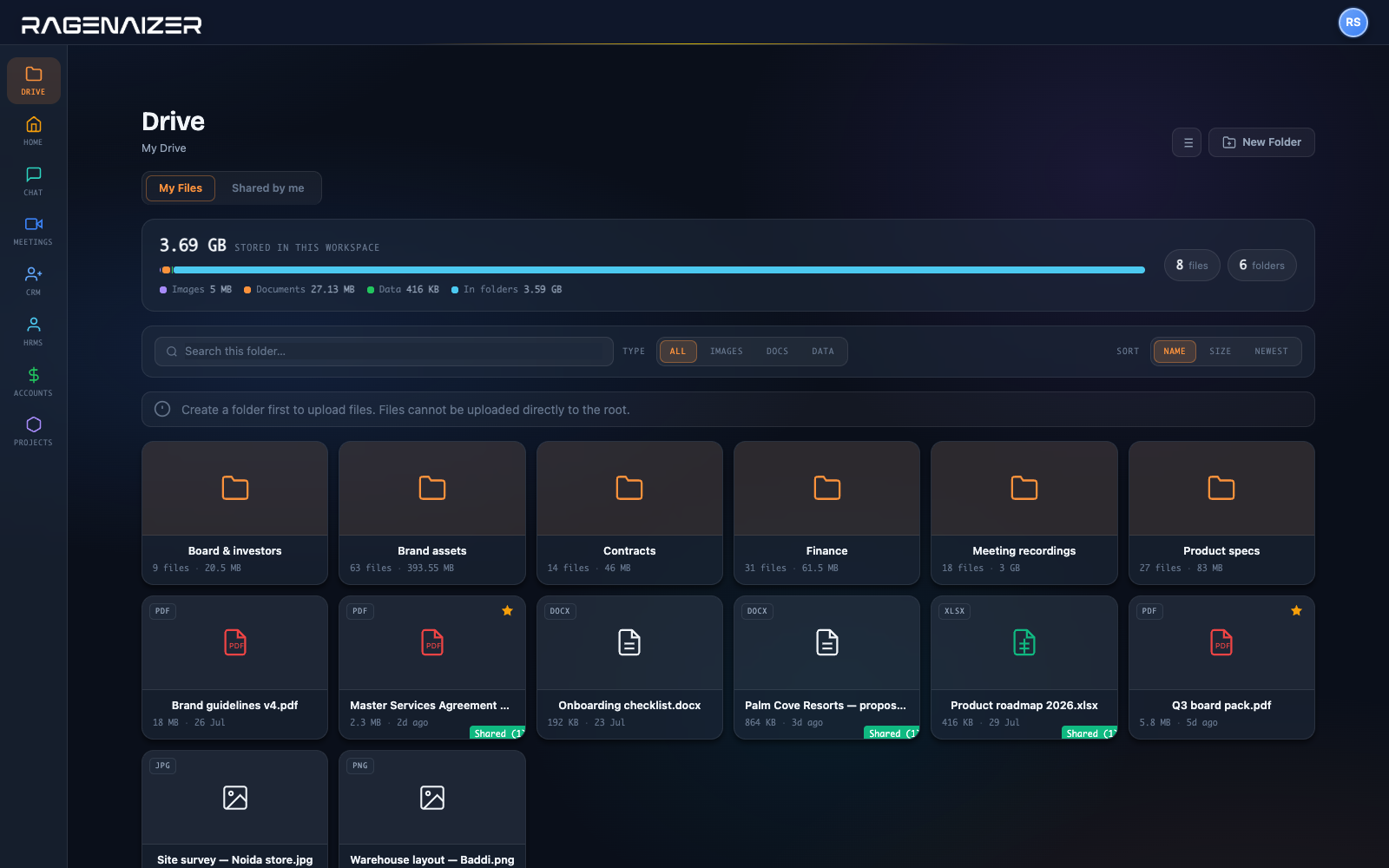
Storage that behaves like a business asset.
The parts that matter when the files are contracts and board packs rather than holiday photos.
The things people ask on the first call.
Can we take a shared link back?
Yes. Revoking removes the share, and the next person to click it gets nothing. You can also change a live link — tighten it to view-only, add an expiry, lower the download cap — without sending a new one.
Can a link be password protected?
Yes, and the password is stored hashed rather than kept in a readable form. Forwarding the link on its own does not open the file.
What happens with a big file on a bad connection?
Uploads over a certain size go up in chunks. A session can be checked on, resumed, or abandoned — so losing your connection at 80% costs you the last chunk rather than the whole file.
Can we tell who downloaded something?
Yes. Uploads, views, downloads, shares and deletions are recorded against the file and the person, and download counts sit on the share itself against the limit you set.
What can a share link do?
View, download, or edit — chosen when you create it. Combined with a password, an expiry and a download ceiling, that is four independent dials on one link rather than "public" and "private".
Do meeting recordings come here?
Yes, automatically. A recorded meeting is uploaded into Drive when it finishes, which is why the platform can promise the recording stays in your workspace.
Is it a separate subscription?
No. Drive is one of the apps in the seat block, and it is where the other apps put things — chat attachments, meeting recordings, documents from the rest of the platform.
Stop emailing files you cannot get back.
Share with a password, an expiry and a limit — and revoke it the day the deal falls through.
This is one module of the business OS, not a point tool. The same seat opens Meetings, Mail, Chat, Drive, CRM, HR, Accounts, Projects, Procurement, Learning and Research — eleven modules covering about twenty-eight products' worth, on one login, one permission model and one ledger. You are not buying a file store; you are putting the company on one system.